News
AI Agents Consume Over 100 Times More Electricity Than Standard Chatbots, KAIST Study Finds
Researchers at South Korea's KAIST have calculated the real energy cost of AI agents for the first time: a single complex query consumes an average of 348 watt-hours, 136.5 times more than a standard chatbot.
Contents
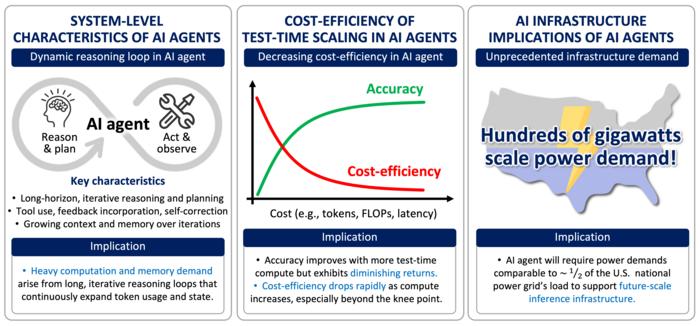
A team from the Korea Advanced Institute of Science and Technology (KAIST) is the first to measure how much electricity an AI agent consumes while carrying out a complex, multi-step task. The result surprised even the researchers themselves: a single query to an agent built on a 70-billion-parameter model uses an average of 348.41 watt-hours of energy, 136.5 times more than the response of a standard chatbot.
The difference between a chatbot and an agent is not cosmetic. A chatbot receives a question, generates an answer, and finishes its work. An agent receives a goal, such as planning a trip or managing a budget, and breaks it down into steps on its own: it searches the internet, performs calculations, runs external tools, and repeatedly returns to its own reasoning before considering the task complete.
Where the cost comes from
The authors of the study, published under the title The Cost of Dynamic Reasoning: Demystifying AI Agents and Test-Time Scaling from an AI Infrastructure Perspective, point to two mechanisms. The first is the very nature of agentic reasoning: the model must run its core computations multiple times before arriving at a final answer, which alone multiplies energy consumption compared to a single text generation pass.
The second mechanism is less obvious and more costly in business terms. When an agent waits for a response from an external tool, such as a search result or an API call, the expensive graphics processor sits idle but still draws power. KAIST researchers calculated that this happens for more than half of the entire task execution time, a waste of computing power that the data center operator still has to pay for.
Our study is the first to quantify how much electricity and cost is required to deploy this intelligence - Minsoo Rhu, professor, KAIST School of Electrical Engineering
The bill at full scale
The most troubling number in the study concerns not a single query but scale. If AI agents began handling 13.7 billion requests per day, the current level of global traffic on Google's search engine, the combined energy demand of data centers would reach approximately 198.9 gigawatts. That is roughly the equivalent of half the average electricity consumption of the entire United States.
Such a level of demand significantly exceeds the current capacity of power grids and existing data centers. The authors stress this is not a distant future scenario, AI agents are already being deployed at scale by companies such as Microsoft, Google, and Salesforce as assistants for office tasks, customer service, and programming.
What the researchers propose
The KAIST team argues that improving software alone will not be enough to solve this problem. In their view, the entire technology stack needs to be redesigned from the ground up, including AI models, chip architecture, and how power is managed in data centers, before the scale of agent deployment collides with the physical limits of the power grid.
The finding also has practical implications for companies already deploying AI agents to automate processes. The energy cost of such deployments is often hidden within cloud computing bills and rarely reported separately, which makes it difficult to realistically assess the cost-effectiveness of large-scale agent projects.
What it means for the industry
The KAIST study provides the first hard numbers in a discussion that has so far relied mainly on cloud providers' estimates and reports of data centers' growing electricity demand. For tech companies planning infrastructure investments for agentic AI, this means factoring in significantly higher energy costs than for classic chatbots, and for power grid operators, it is a signal that the pace of agent deployment could outrun the pace of generating capacity expansion.
Sources: Advanced AI uses 136.5 times more electricity than standard chatbots, study warns (koreatimes.co.kr), KAIST identifies the hidden energy cost of AI agents for the first time (eurekalert.org)