News
Claude Sonnet 5 Becomes Anthropic's New Default Model

Anthropic has rolled out Claude Sonnet 5 as the default model for all Free and Pro plan users, touting performance close to Opus 4.8 at a significantly lower price.
Contents
Anthropic has released Claude Sonnet 5 and immediately made it the default model for both free and paid Pro accounts, replacing the previous Sonnet 4.6. The company calls it the most agentic model in the Sonnet family it has ever shipped.
What's New in Sonnet 5
The new model can independently plan multi-step tasks, use a browser and a terminal, and run longer work sessions without user supervision. According to Anthropic, Sonnet 5 completes complex tasks where earlier Sonnet versions used to stall, and it verifies its own output on its own, without needing an extra prompt.
In the BrowseComp and OSWorld-Verified benchmarks, the new model offers a wider range of cost-to-performance settings than its predecessor, and at certain compute-effort levels it matches the capabilities of the far more expensive Opus 4.8. That's a notable shift, since this kind of autonomous work previously required the largest, priciest model in the lineup.
What It Costs Businesses
Anthropic also introduced promotional pricing running through August 31, 2026: $2 per million input tokens and $10 per million output tokens. After that date, rates rise to the standard $3 and $15 per million tokens. For businesses using the API, that's still noticeably cheaper than Opus while retaining much of its agentic capability.
The model is also available in Claude Code and through the Claude API under the name claude-sonnet-5, and users on Max, Team, and Enterprise plans can switch to it manually. For companies building developer tools or automations, this means access to a more powerful engine without paying rates previously reserved for the priciest models.
Safety and Risk Mitigation
Anthropic says Sonnet 5 exhibits unwanted behavior less often than Sonnet 4.6, is better at refusing malicious requests, and more effectively resists prompt-injection attempts. The company also reports a lower tendency toward hallucination and excessive agreement with users, which matters for tasks carried out without ongoing human oversight.
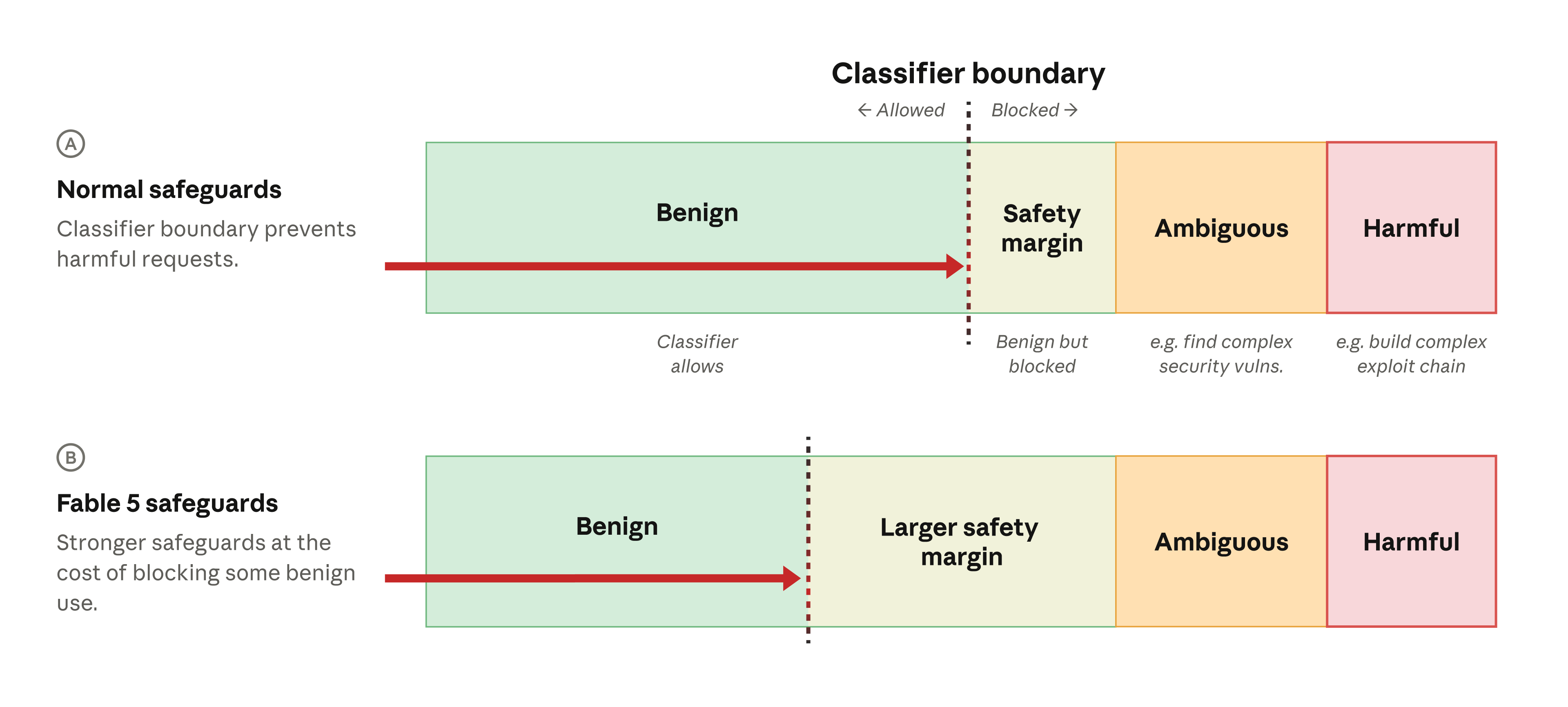
Cyber safeguards are enabled by default in the model, though less restrictive than those on Fable 5, which Anthropic attributes to a lower risk profile for Sonnet 5 being used to develop exploits. This reflects the company's broader policy of calibrating safeguards to the actual risks a given model can pose.
What It Means for Polish Users
For Polish companies and developers using Claude, this means the default experience in the app and in Claude Code has automatically become more agentic, with no need to change settings manually. Teams that built automations around Sonnet 4.6 should check how the new version behaves in their specific workflows, especially where the model has access to external tools.
The launch is part of the ongoing race between Anthropic, OpenAI, and Google for the title of provider with the most autonomous agentic models. Sonnet 5 is meant to answer growing price pressure from competitors while preserving a quality edge in everyday coding and office tasks.
Sources: Introducing Claude Sonnet 5 (anthropic.com), Anthropic debuts Claude Sonnet 5 for everyday agent tasks with lower cyber risk (axios.com), Claude Sonnet 5 Ships as Anthropic Default (techtimes.com)