News
US Lifts Export Ban on Claude Fable 5 and Mythos 5
After 18 days of restrictions, the US government restored access to Anthropic's most powerful models after the company deployed a new safety classifier that blocks a known jailbreak technique in more than 99 percent of cases.
Contents
The U.S. Department of Commerce lifted export controls imposed on Anthropic's Claude Fable 5 and Claude Mythos 5 models on June 30, 2026, and access to them was restored globally starting July 1. The ban lasted 18 days, cutting off access to Anthropic's most powerful models even for the company's own employees located outside the US.
Reason for the Original Ban
The ban came about after the Trump administration learned of a discovery by a team of Amazon researchers, who found a way to bypass Fable 5's safeguards that could allow the model to be used for offensive cybersecurity tasks. The Department of Commerce imposed export controls on June 12 without detailed public justification, cutting off foreign users, including Anthropic's own employees outside the US, from access to the model for over two weeks.
The company treated the matter as a priority. Rather than challenging the government's decision, Anthropic focused on patching the specific vulnerability described by Amazon's researchers and preparing evidence that the problem had been resolved.
How the Safeguards Were Fixed
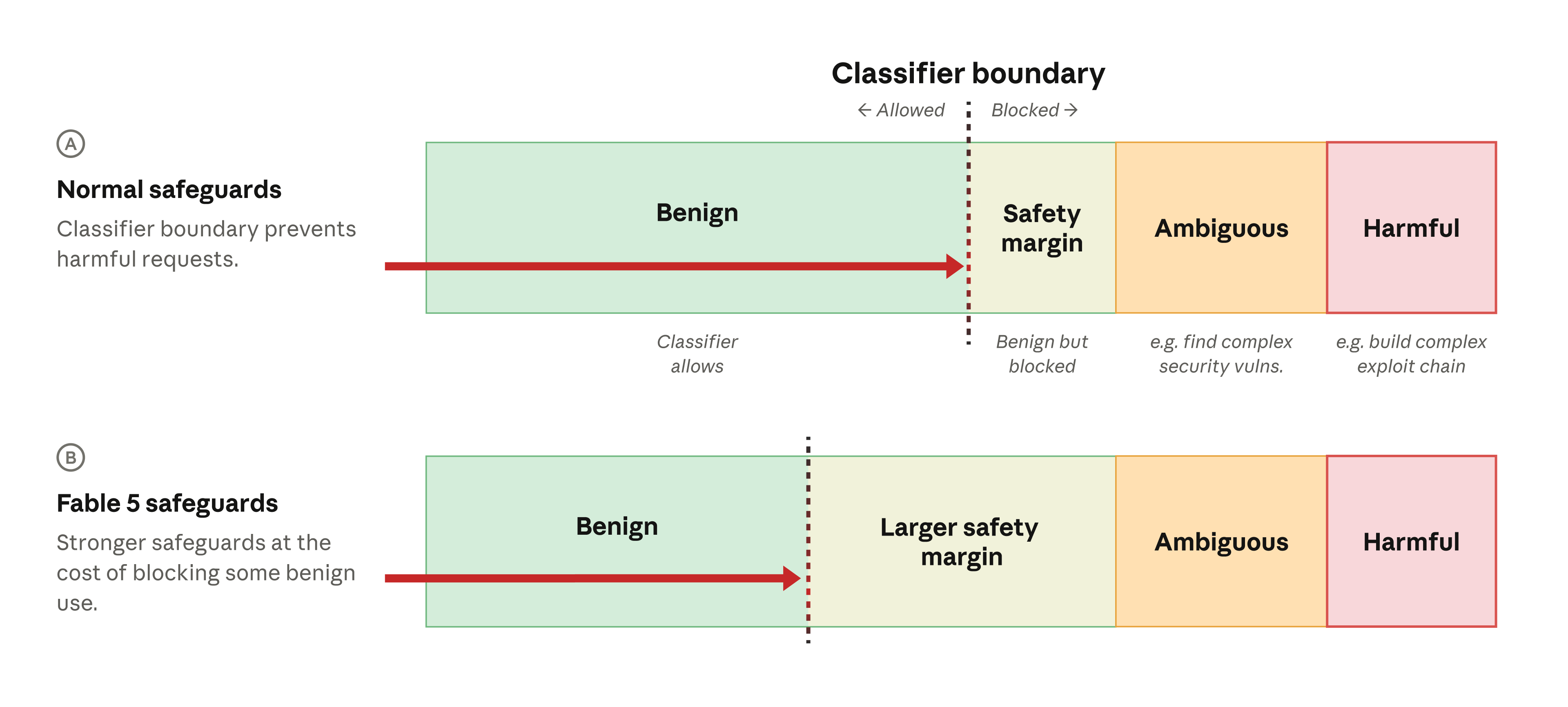
Anthropic deployed an improved safety classifier to detect potentially harmful cybersecurity-related tasks, based on an approach described as layered defense. It combines several independent abuse-detection mechanisms, deliberate safety margins that block some harmless queries in order to reduce the risk of jailbreaks, and retrospective analysis of detected abuse patterns.
The new classifier means that the specific technique described in Amazon's report is blocked in more than 99 percent of cases - Anthropic
We worked closely with Anthropic to review and clear Fable 5, strengthening America's leadership in artificial intelligence - Howard Lutnick, US Secretary of Commerce
At the same time, Anthropic acknowledges that full resistance to jailbreaks remains unattainable. The company stressed in its statement that it is likely impossible to build an AI model completely immune to attempts to bypass its safeguards, which is why it relies on layered abuse detection rather than a single, perfect filter.
Context of the Broader Dispute with Washington
The export case is another chapter in Anthropic's tense relationship with the Trump administration. Earlier in 2026, a separate dispute arose when the Pentagon sought Anthropic's consent to use Claude for tasks related to mass surveillance and autonomous lethal weapons, which the company refused. The lifting of the export ban on Fable 5 and Mythos 5, however, concerns a different matter, restrictions imposed for cybersecurity reasons, not that dispute over military applications, which remains unresolved in court.
For the global AI market, the decision matters beyond the company itself. For 18 days, foreign customers and researchers had no legal access to one of the most powerful models available, giving a temporary edge to competitors, chiefly Google DeepMind, whose Gemini models remained available without interruption throughout the ban.
What This Means for Companies Using Claude
For companies and institutions outside the US using Anthropic's API, the episode shows that access to state-of-the-art models can be cut off overnight by an administrative decision, regardless of the quality of the product itself. Restored access to the enterprise version of Mythos 5 still requires an organization to hold US government-approved status, which in practice could complicate deployment plans for companies outside the United States' security alliances.
Sources: Redeploying Claude Fable 5 (anthropic.com), Trump Just Cleared Anthropic to Go Global, and Google DeepMind Should Be Sweating (247wallst.com), U.S. lifts ban on Anthropic's powerful Fable 5 AI model (nbcnews.com)