News
Bristol Myers Squibb First Pharma Company to Deploy Nvidia Vera Rubin Supercomputer
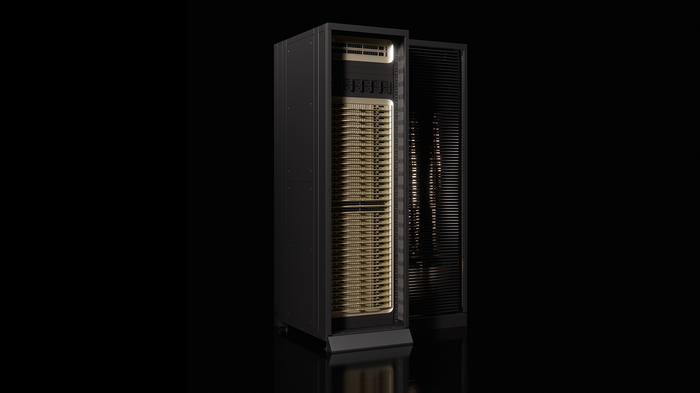
Bristol Myers Squibb is expanding its three-year partnership with Nvidia by deploying a DGX SuperPOD system based on the Vera Rubin NVL72 architecture to speed up drug discovery. The company says it is the first pharmaceutical firm to buy a SuperPOD of this generation.
Contents
Bristol Myers Squibb has announced an expansion of the Nvidia-based computing infrastructure it uses for drug discovery. The company is deploying an NVIDIA DGX SuperPOD built on DGX Vera Rubin NVL72 systems, and says it is the first life sciences company to purchase a SuperPOD based on this generation of Nvidia's architecture.
A new computing platform
DGX Vera Rubin NVL72 is Nvidia's newest computing platform, unveiled at this year's CES, combining 72 Rubin GPUs and 36 Vera CPUs in a single system linked by high-speed NVLink. Bristol Myers Squibb chose to deploy this architecture as a SuperPOD-class cluster, which the company describes as a factory for AI models used in drug research.
According to the manufacturer, the new generation of chips delivers up to ten times the performance per megawatt compared with the previous Blackwell architecture. For a pharmaceutical company, that means the ability to train and run substantially larger foundation models without a proportional increase in data center energy consumption.
Three years of partnership
Bristol Myers Squibb's collaboration with Nvidia began roughly three years ago, when the company deployed its first DGX SuperPOD to support its research and development division. Since then, the company's AI applications have evolved from simpler tools, such as protein structure prediction, to far more computationally intensive foundation models describing how drug candidates interact with the human body.
We used up all the compute space we had - Greg Meyers, Chief Digital and Technology Officer, Bristol Myers Squibb
The infrastructure expansion, then, stemmed directly from exhausting existing resources. The new system is meant to support foundation models used in research into oncology and neurodegenerative diseases, among others, and will eventually extend to hematology, cardiology, immunology and neurology more broadly.
What it means for drug research
The added computing power is meant to let BMS researchers screen far more drug candidates at the earliest stage of development, before they move on to costly lab and clinical testing. The company stresses that the goal isn't just speeding up the process, but above all improving the accuracy of choosing which programs are worth pursuing in the first place.
Before, we might have been able to screen maybe ten candidates, now we can screen dozens - Robert Plenge, Chief Research Officer, Bristol Myers Squibb
According to the company, AI tools have already cut the time needed to prepare drugs for clinical trials by 20 to 30 percent, and in the coming years that figure could rise to as much as 50 percent. The company has not disclosed the financial terms of its agreement with Nvidia or an exact timeline for bringing the new cluster to full capacity.
A race among pharma supercomputers
According to STAT News, Bristol Myers Squibb's announcement is already the third such declaration in nine months from a pharmaceutical company building its own large Nvidia-based computing cluster for research purposes. Pharmaceutical companies are increasingly treating access to supercomputer-class computing power as a competitive edge in the race to discover drugs faster, alongside traditional advantages like the size of a research portfolio or access to clinical data.
A similar trend is visible beyond the largest companies. Smaller biotech firms, including Polish startups working on AI-assisted drug design, are also increasing their investment in computing infrastructure, though on a far smaller scale than global pharmaceutical companies with research budgets in the billions of dollars.
For Poland's biotech sector, investments of this kind show where the whole industry is heading, one in which access to computing power is becoming as important as access to laboratories. Domestic pharmaceutical and biotech companies currently lack comparable resources at scale, which could, over the longer term, affect how quickly they are able to compete for the most promising research programs.
For Nvidia, deals like this offer further proof that its AI hardware is reaching well beyond typical cloud data centers and tech companies, extending into the pharmaceutical industry, where demand for computing power is growing alongside ambitions to build ever larger foundation models describing human biology.