News
AI Model DiffuDose Calculates Targeted Radiotherapy Dose in 23 Seconds Instead of Hours
Researchers at the University of Massachusetts Amherst developed DiffuDose, an AI model that calculates personalized radiation doses for prostate cancer radioligand therapy in under 23 seconds, matching the accuracy of the previous method that required hours of computation.
Contents
A biomedical engineering team at the University of Massachusetts Amherst has built an AI model that calculates, in under 23 seconds, how much radiation each of a patient's organs will absorb during radioligand therapy for prostate cancer. The previous gold-standard method could take hours per patient, which in practice blocked large-scale dose personalization.
Two Models in One
DiffuDose relies on two cooperating AI modules. The first produces an initial, rough estimate of the radiation dose based on images taken after the therapy is administered. The second module, built on a diffusion architecture, turns that rough estimate into a detailed, pixel-by-pixel map of radiation distribution across the patient's entire body.
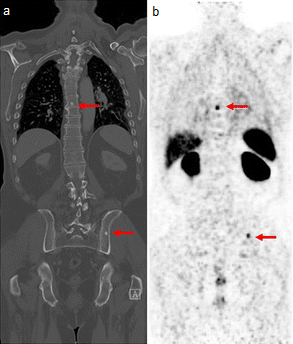
The therapy at the center of the study is 177Lu-PSMA radioligand treatment used for prostate cancer patients. The radioactive drug binds to prostate-specific membrane antigen on the surface of tumor cells and destroys them with beta radiation emitted from inside the tumor. The problem is that the dose absorbed by different organs, especially the kidneys and bone marrow, varies significantly between patients depending on body composition, metabolism, and the distribution of metastases.
Same Dose for Everyone
Current clinical practice in most cases relies on a standard drug dose, identical for every patient, even though pharmaceutical companies have invested billions of dollars in developing radioligand therapies. Precise dosing based on individual dosimetry has long existed as a computational method, but its time-consuming nature meant it was rarely used in routine care.
Right now, everybody gets the same dose. That essentially leaves the therapy's potential untapped - Joyita Dutta, professor, Riccio College of Engineering, University of Massachusetts Amherst
Pixel by pixel in a full image, you could see how the dose was distributed across the body - Joyita Dutta, professor, University of Massachusetts Amherst
Matching the Gold Standard
The model's creators compared its results with the Monte Carlo method, considered the benchmark for precision in medical dosimetry. DiffuDose matched that gold standard while cutting analysis time from hours to seconds. In tests against six competing computational methods, the new model performed best overall, particularly in estimating doses to the kidneys and liver, the organs most vulnerable to side effects from radioligand therapy.
What's Next for the Research
The UMass Amherst team announced further collaboration with UMass Chan Medical School on additional AI models that would combine post-therapy imaging data with blood test results to better predict how a specific patient will respond to treatment. Bowen Lei, the paper's lead author, is a Young Investigator Award candidate at the 2026 IEEE conference, suggesting the project is gaining recognition in the medical imaging research community.
Relevance for Polish Patients
Radioligand therapies based on 177Lu-PSMA are also available in Poland, including as part of advanced prostate cancer treatment programs at select oncology centers. Tools like DiffuDose could eventually make it easier to roll out personalized dosimetry without needing additional medical physics staff for hours-long calculations, which can be a real bottleneck at smaller centers.
The paper's authors have not yet given a timeline for clinical trials or disclosed the size of the patient dataset used to train the model. Before the tool reaches everyday hospital practice, it will need to undergo regulatory validation and prove its effectiveness in a larger patient group, a process that typically takes several years in medical imaging.