News
DeepMind: AI Writes Over 75% of Its Code, but Research Isn't Speeding Up
The Gemini 4 Argon safety report shows AI writes more than 75 percent of production code at Google DeepMind. The team still sees no measurable acceleration of AI research driven by AI itself.
Contents
Google DeepMind has used a safety report to address whether AI is accelerating research into itself. The answer: although AI writes more than 75 percent of the lab's production code, the team has not observed any measurable acceleration of AI research driven by AI.
What DeepMind found
The findings come from the Safety & Security Report for Gemini 4 Argon, whose model card was published on October 13, 2026. DeepMind's Haydn Belfield described the results on October 14. According to The Decoder, the team currently rates the risk from AI-driven research automation as low.
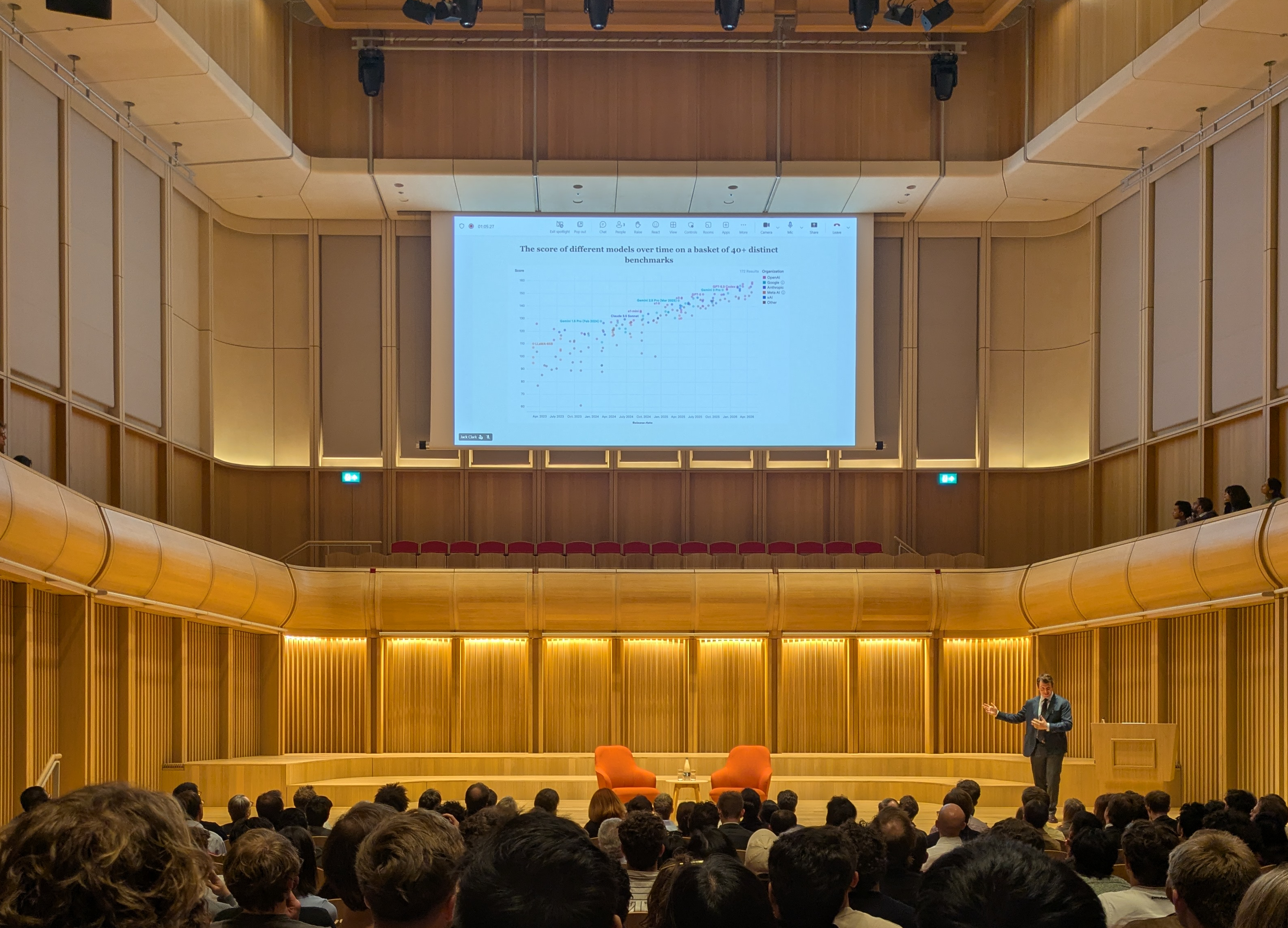
The team built a General Capability Index (GCI) covering 123 models and 92 benchmarks. By this measure, Gemini model capabilities are growing at a steady pace of about 0.1 GCI points per month, with no statistically significant acceleration, DeepMind says.
Gemini 4 Argon sits slightly above the trend line. The authors attribute this to more compute and organizational investment rather than AI-driven acceleration.
AI writes the code, humans decide
More than 75 percent of production code is written by AI, but about 88 percent of code changes still need human oversight or review. The share of changes fully delegated to AI rose from 7.5 to 11.9 percent, and every change is reviewed by a human, The Decoder reports.
An analysis of 1,389 internal Argon agent runs showed that the success rate without human input drops sharply as task complexity increases. On RE-Bench, which covers 74 realistic ML engineering tasks, Argon solves about half, while Gemini 3.7 Flash solves 27 percent. That is far from the level full automation would require.
A survey of twelve senior DeepMind researchers shows the same pattern: automation is highest for well-defined, verifiable tasks and lowest for open-ended scientific ideation. Belfield adds that humans remain essential for creative research, designing novel experiments, diagnosing subtle training instabilities and long-term planning.
The self-improving AI debate
In the Frontier Safety table for the loss-of-control scenario, the Gemini 4 Argon model card on DeepMind's site lists "CCL not reached" for "ML R&D acceleration level 1", meaning the critical capability level has not been reached. The same applies to the ML R&D automation level.
DeepMind's conclusion contrasts with voices elsewhere in the industry. The Decoder notes that more than 20 researchers, including Geoffrey Hinton, Yoshua Bengio and OpenAI's Jakub Pachocki, warned in a paper of a possible "intelligence explosion" in which AI could automate all AI research within a few years.
Limits of the data
This is data from a single company and its own assessment, without independent verification. The team says it is building measurement infrastructure to detect any signs of acceleration. For Polish engineering teams, the practical takeaway is a cautious one: even in a lab with access to the newest models, much of the work on code still requires a human.