News
Polish Engineer Builds 3D-Printed Robot That Acts Out an AI Agent's Work
Krzysztof Jamroz, an engineer at OLX in Kraków, has open-sourced Tiny Engineer, a desktop robot that physically acts out what an AI coding agent is doing in real time.
Instead of staring at a progress bar in a code editor, you can now glance at your desk. Polish engineer Krzysztof Jamroz has released Tiny Engineer, a small 3D-printed robot that acts out in real time what an AI agent is doing while it works on code: reading files, thinking, typing, and finally ringing a bell when it's done.
A physical stand-in for the progress bar
Jamroz, who leads engineering teams at OLX in Kraków in his day job, wanted to solve a simple problem: when working with a coding agent, it's hard to tell at a glance whether the program is still doing something or has already finished. Instead of yet another spinner or status line in a terminal, he built a physical "little colleague" that sits on the desk and visibly reacts to every stage of the agent's work.
The robot isn't limited to a single animation. When the agent is reading files, Tiny Engineer takes on a pose of concentration. When it's generating code, the robot taps away at a miniature keyboard. When a task finishes, the robot rings a small bell, signaling that it's time to look back at the screen.
What's inside
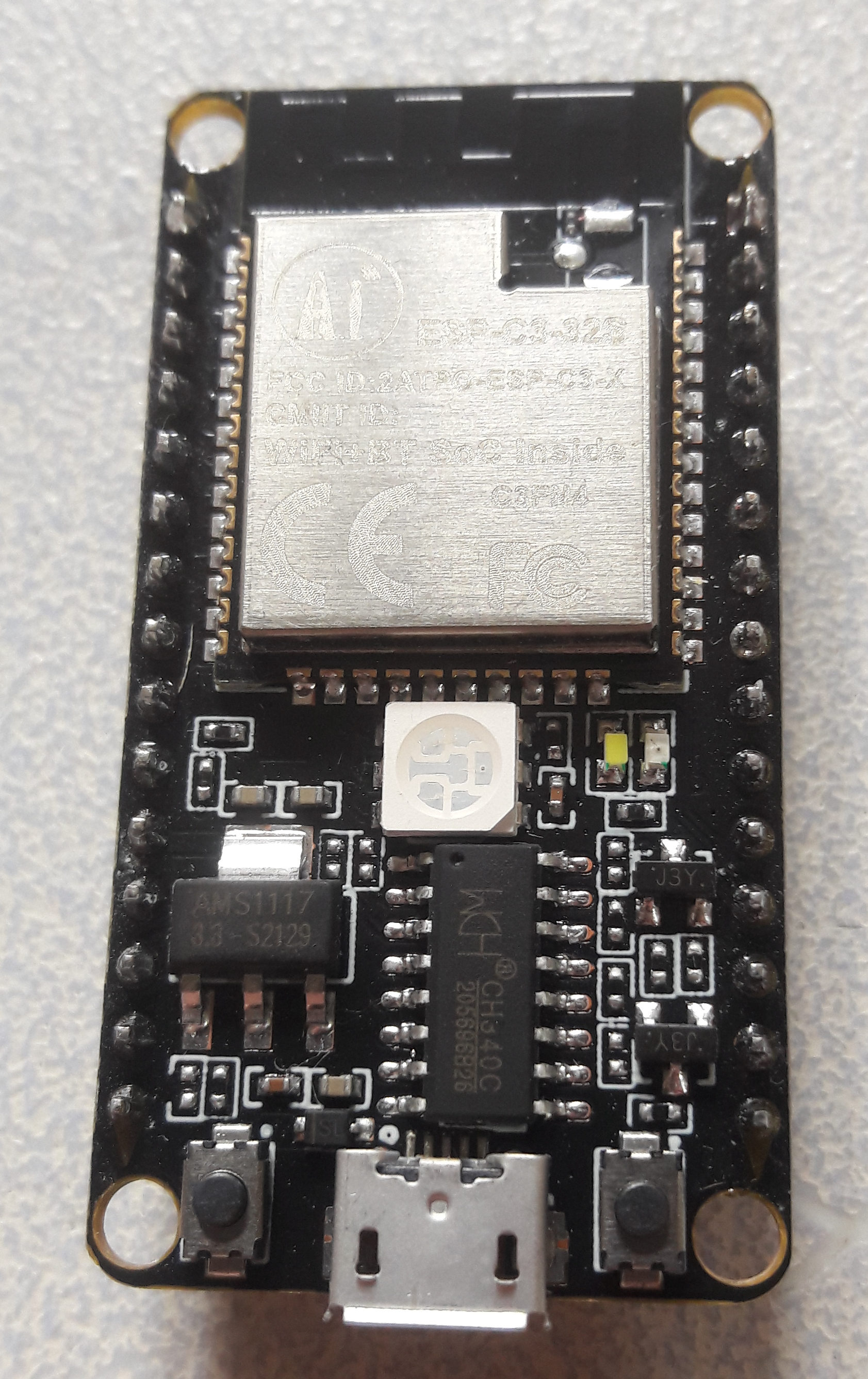
The heart of the device is a Waveshare ESP32-C3-Zero board, chosen for its small size while still offering Wi-Fi connectivity and enough processing power to handle the animations. To drive the five PowerHD HD-1370A micro servos that move the robot's head, neck, arms and body, Jamroz added a dedicated PCA9685 PWM controller, since direct control from the ESP32 alone turned out to be insufficient.
The robot's eyes are a 0.91-inch SSD1306 OLED display connected over the I2C bus, animated to give the impression of blinking and emotion. On top of that sits a MAX98357A amplifier with a small speaker, responsible for sound effects, including the signature bell that rings when a task is done.
The biggest challenge with the ESP32 was size. I chose the ESP32-C3-Zero because I needed Wi-Fi and enough power to run the robot - Krzysztof Jamroz, creator of Tiny Engineer
Not tied to one tool
A key design decision concerned how the robot integrates with AI agents. Rather than locking the robot to a single tool, Jamroz designed the ESP32 to host a simple REST API server available on the local network. Any application capable of sending an HTTP request can trigger a specific animation, whether a nod, a gesture, a thinking pose, or a completion signal.
Jamroz himself currently uses Cursor hooks that translate coding-agent events into animation commands sent to the robot. The same interface, as the project's documentation notes, can just as easily be connected to Claude, Codex, or any custom monitoring script. The open architecture also means the project could be repurposed to monitor something entirely different from an AI agent, such as the state of a CI queue or a data pipeline.
Why it matters
Tiny Engineer fits into a growing trend of "physical interfaces" for developer tools that increasingly run in the background, autonomously, without constant supervision in an editor window. As coding agents take on more and more tasks, developers are looking for ways to avoid having to constantly check a process's status on screen, and a physical object on the desk, visible out of the corner of the eye, is one of the simplest solutions to that problem.
For the maker and DIY community, the project is also an example of how inexpensive hobbyist components, a board costing a few dollars, a handful of micro servos, a small OLED display, can come together into a complete, reproducible device with full production documentation: schematics, a bill of materials, and 3D-printing files.
The project first appeared on Reddit, on the r/esp32 subreddit, where the author posted it under the username jamropl, before technology outlets, including Hackster.io, wrote it up. Krzysztof Jamroz has more than two decades in the technology industry, including roles as a systems architect and engineering team lead, and previously ran his own game studio, whose titles have racked up more than 100 million plays.