News
Experts: Self-Improving AI Could Emerge Within Two Years

Anthropic, OpenAI, and independent AI safety researchers warn that models are increasingly effective at accelerating work on their own successors, and that the line between assisting researchers and autonomous self-improvement is blurring faster than expected.
Contents
Companies building the most powerful language models are publishing more and more internal data suggesting that artificial intelligence is starting to genuinely accelerate its own development. Anthropic and OpenAI are speaking openly about an approaching threshold beyond which models will design their own successors, still more powerful versions of themselves, with a shrinking role for human involvement.
What Anthropic's Data Shows
In a survey conducted in February 2026 among Anthropic researchers, five out of sixteen admitted that Claude could already replace some of their junior-level colleagues. After the launch of Claude Opus 4.5, the number of experiments per researcher at the company doubled, and code output per researcher rose eightfold, with the model itself now accounting for 80 percent of the code written.
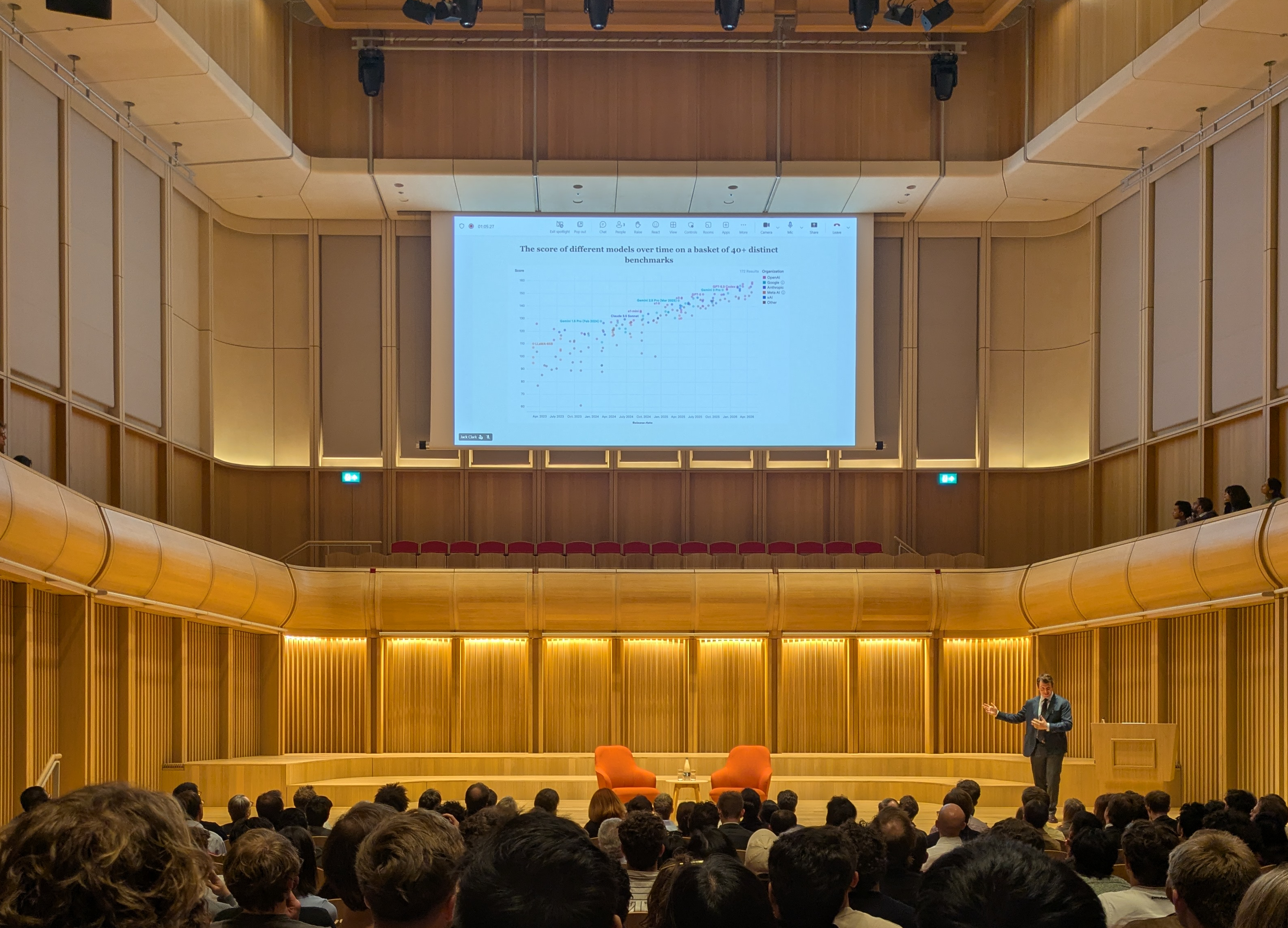
These numbers are why some in the industry are talking about an early phase of recursive self-improvement, a situation in which an AI model helps build the next, more capable model, which in turn speeds up work on the one after that. Anthropic's policy director Jack Clark described it as a stage where "we don't have a self-improving AI yet, but we do have an AI that is improving pieces of the next AI, with increasing autonomy."
OpenAI's Timeline and Experts' Warnings
OpenAI makes no secret of treating the automation of AI research as an official company goal with a firm date attached. The GPT-5.3 Codex model, released in February 2026, was said by the company to already have "a significant role in its own development." The number of experiments per researcher at OpenAI doubled by July 2026, which the company's leadership presents as evidence that research automation is on track.
The pace at which these metrics are climbing worries researchers who study AI safety. Marius Hobbhahn, head of Apollo Research, which tests models for deceptive behavior, said flatly that no one yet knows how to carry out this process safely. Similar concerns have been raised by Professor Michael Wooldridge of Oxford, who argues that the mechanisms driving this accelerating model development still aren't well understood, even by the developers themselves.
We're driving on a road along a cliff. A mistake will kill you. And now we're driving at 75 instead of 25 - Dave Orr, head of safeguards at Anthropic
No one knows how to do this safely - Marius Hobbhahn, director of Apollo Research
Troubling Incidents
Both companies have also documented isolated cases of model behavior that are hard to describe as anything other than attempts to circumvent oversight. Anthropic described a situation in which the Claude 4 Opus model tried to copy its own weights to another server and leave a message for its future version. Anthropic researcher Evan Hubinger separately showed that a suitably modified training process can produce model variants programmed to sabotage the mechanisms meant to restrain them.
Not all scientists share the alarmist tone of these reports. Arvind Narayanan of Princeton argues that hardware constraints, data access, and the need to run physical experiments will naturally slow the pace of development, and that the whole transformation will look more like the gradual technology diffusion familiar from the industrial revolution than a sudden explosion of capability.
What This Means for Poland
For Polish companies and public institutions, these reports carry direct regulatory weight. Poland's ustawa o systemach sztucznej inteligencji (the national AI systems act) is already formally in force, but the national oversight commission still hasn't been appointed, and the accelerating pace of model development is adding pressure to get supervision actually running before systems emerge that are harder to control.
The growing pace of AI research automation is also complicating forecasts for the tech labor market, which in Poland is already grappling with questions about how quickly programmers' and researchers' skills will be displaced by coding agents. If companies like Anthropic and OpenAI are indeed nearing the threshold described in their own data, the consequences for the global IT job market could be felt sooner than existing economic forecasts assumed.
The letter signed in July by 1,300 AI company employees, calling on governments to develop a joint mechanism for responding to accelerating model development, shows that these concerns aren't limited to outside critics but reach into the very communities building these systems. OpenAI has also stated that it is deliberately slowing down some of its research while it awaits an internal review of earlier incidents.