News
Tourists in the Tatras Trusted AI, Ended Up on a Climbing Route, Needed a Helicopter Rescue
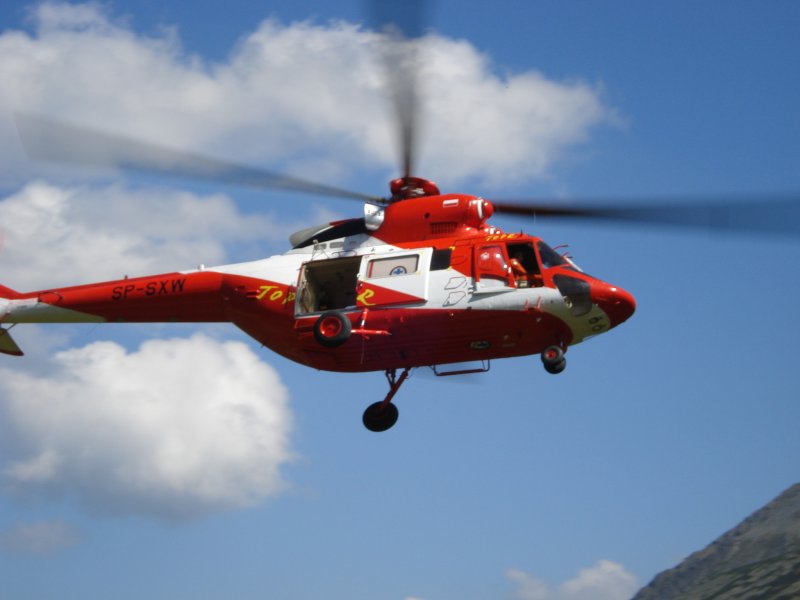
Two tourists from Lithuania followed an AI-suggested shortcut and got stranded on a climbing route below Niebieska Turnia in the Tatra Mountains. TOPR evacuated them by helicopter during one of the busiest rescue weeks of the summer.
Contents
Two tourists from Lithuania were looking for a shortcut to the Valley of the Five Polish Lakes (Dolina Pięciu Stawów Polskich). They asked an AI chatbot for directions, got a suggestion to cross Świnicka Ławka, a rocky ledge, and soon found themselves on difficult, climbing-grade terrain below Niebieska Turnia (Blue Turret), unable to descend on their own. On Saturday, July 4, a helicopter from TOPR (Tatra Volunteer Search and Rescue) had to fly out to get them.
Świnicka Ławka is not a marked hiking trail in the sense most hikers would understand the term. It's a climbing passage that requires experience, proper footwear, and orientation in high-mountain terrain. For someone simply planning to shorten their route to the popular Valley of the Five Polish Lakes, a suggestion like that can end exactly the way it did for the two Lithuanians, stuck on the rocks and calling for help.
How the Accident Happened
According to rescuers' accounts, the tourists planned their route based on an AI chatbot's suggestion for the shortest way. The tool proposed crossing Świnicka Ławka without apparently accounting for the fact that it's a route meant for people with climbing experience, not for an average tourist looking for a shortcut in the middle of summer. The pair ended up in terrain they could neither retreat from nor safely continue through, and called TOPR.
Rescuers reached the scene and evacuated both tourists by helicopter. The operation itself was no different from dozens of others TOPR runs every summer, but its cause, a route suggested by AI, sets it apart from the typical call-outs tied to exhaustion, injuries, or sudden weather changes.
A Week Full of Rescues
The accident below Niebieska Turnia coincided with one of the most demanding periods for Tatra rescuers this season. In the first week of July, TOPR helped 55 people in total, with Saturday, July 4 alone bringing 25 separate call-outs. That day the helicopter flew into the high Tatras several times, evacuating, among others, climbers from the northeast face of Mięguszowiecki, a researcher with a broken leg after leaving an ice cave, and a tourist trapped below Bystra who was located with a drone and spent the night on site with survival gear delivered by rescuers.
Once again, we are urging people to choose their mountain destinations sensibly - TOPR
Rescuers also stress that mountain accidents tend to come in clusters, especially during periods of heavy tourist traffic. In such situations, reaching those in need of help can be much harder, particularly when the helicopter is already committed to another operation.
Not the First Such Case
This is not the first time a route suggested by a chatbot has landed tourists in trouble in the Tatras. A similar case was recorded last winter, when tourists asked a chatbot for the shortest route and it proposed a path without accounting for the snow conditions at the time. In both cases the problem is the same: conversational tools can point out the geographically shortest line between two points, but they don't always recognize that a given stretch requires climbing experience, a rope, or proper footwear, or that weather and snow conditions can change a route's character from one day to the next.
For mountain rescuers this is a practical problem, since the use of AI assistants for trip planning is growing alongside the popularity of these tools, while hiking maps and official trail descriptions remain a far more accurate source of information about difficulty and markings than a chatbot's general answer.
What This Means for Tourists
For Polish and foreign tourists planning trips to the Tatras, this is a concrete warning: an AI suggestion about a route doesn't replace a map, knowledge of trail markings, or checking current conditions directly with TOPR or Tatra National Park (Tatrzański Park Narodowy). AI is very good at suggesting routes based on distance, but it bears no responsibility when a shortcut turns out to be a cliff edge, and the mistake ends up costing a rescue operation and real risk to human life.
TOPR did not specify which AI tool the tourists used, but the story has already been picked up by more than a dozen Polish news outlets as an example of a broader phenomenon: blind trust in suggestions generated by language models in situations where safety, not just convenience, is at stake.