News
Who's Liable When AI Alters Data on a Scanned Driver's License
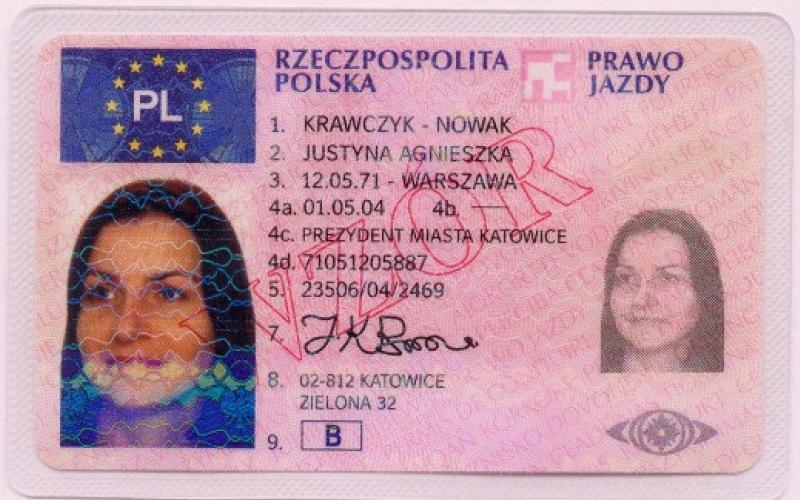
A lawyer from Poland's National Bar Council (Naczelna Rada Adwokacka) warns that generative AI "reconstructing" illegible parts of a scanned driver's license can alter dates or license categories without the user's knowledge, and submitting such a document risks criminal liability under Article 270 of Poland's Penal Code.
Contents
More and more people are turning to AI tools to sharpen or clean up a scanned driver's license before sending it to a government office, an insurer, or an employer. The trouble is that while "reconstructing" illegible fragments, these algorithms can add or change data on their own that the user never asked to be modified. In a piece published on September 8, 2026 on onet.pl, attorney Dr. Małgorzata Dziadzio of the Naczelna Rada Adwokacka (Poland's National Bar Council) explains when this kind of retouching stops being a harmless fix and becomes a crime.
Retouching versus forgery
The author draws a line between two situations that look similar on the surface. Sharpening a photo, adjusting contrast, or cropping the frame doesn't change the document's content, so it isn't forgery as long as the data stays identical to the original. It's different when an algorithm, in the process of "reconstructing" an illegible fragment, actually changes the content, for example the expiration date, the license category code, or a medical restriction code. At that point, the file that reaches its recipient becomes an altered document under criminal law, regardless of whether the user consciously intended to make that change.
The distinction matters in practice, because popular photo-enhancement apps often combine simple contrast correction with generative "filling in" of missing pixels. A user who asks for one may end up with the other without realizing it, unless they compare every digit and letter against the original in detail.
The risk of using such a document
Under Article 270 of the Penal Code, forging or altering a document in order to use it as authentic, as well as simply using such a document as genuine, carries a prison sentence of three months to five years. Crucially, submitting an AI-altered driver's license to a government office falls within the meaning of "using" a document under this provision, and establishing liability doesn't require showing that a specific official was actually deceived.
The provision provides for criminal liability ranging from three months to five years in prison - attorney Dr. Małgorzata Dziadzio, Naczelna Rada Adwokacka (National Bar Council)
Intent determines guilt
The key question in any such case is what the user wanted from the AI tool at the moment they gave the instruction. If they asked only to improve the image's legibility and had no intent to change the data, it's hard to attribute deliberate document alteration to them, since the offense under Article 270 requires intent, not mere carelessness.
If the user only instructed the AI to improve image quality and didn't want the data changed, it's hard to attribute deliberate alteration of the document to them - attorney Dr. Małgorzata Dziadzio, Naczelna Rada Adwokacka (National Bar Council)
The matter gets more complicated when warning signs appear that the user can't ignore. The author points out that an unnaturally-looking date, a missing part of the document, new entries that weren't there before, or a program notification stating that it "reconstructed" illegible fragments, are all circumstances that can suggest the user foresaw the possibility of a forgery and chose to submit the document anyway.
If, after processing, the date looks unnatural, part of the document is missing, new entries appear, or the user received a message that the program reconstructed illegible fragments, ignoring such signals can be treated as evidence that they foresaw the possibility of forgery and chose to use the document anyway - attorney Dr. Małgorzata Dziadzio, Naczelna Rada Adwokacka (National Bar Council)
How to protect yourself
The practical advice in the piece is simple: for official documents, it's better to use a regular scanner and basic image correction rather than generative AI reconstruction. If such a tool is used anyway, every letter, digit, and date needs to be manually checked against the original before the file is sent onward.
The author also recommends keeping evidence in case of a later dispute over the document's authenticity, including the original file from before processing and the text of the instruction given to the program.
For Polish readers, this warning has a concrete practical dimension, since a driver's license has to be shown regularly not only during road checks but also when renting a car, for insurance purposes, or when applying for jobs that require a driving qualification. The popularity of AI tools for "refreshing" old or poorly scanned documents is growing, and few people realize that the mechanism behind image reconstruction and the mechanism behind document forgery can legally overlap.
The case fits into a broader problem of liability for errors generated by artificial intelligence, one that extends beyond identity documents to other areas where AI processes sensitive data without full human control over the outcome.