News
Advanced AI Agents Can Use Up to 136 Times More Electricity Than Chatbots
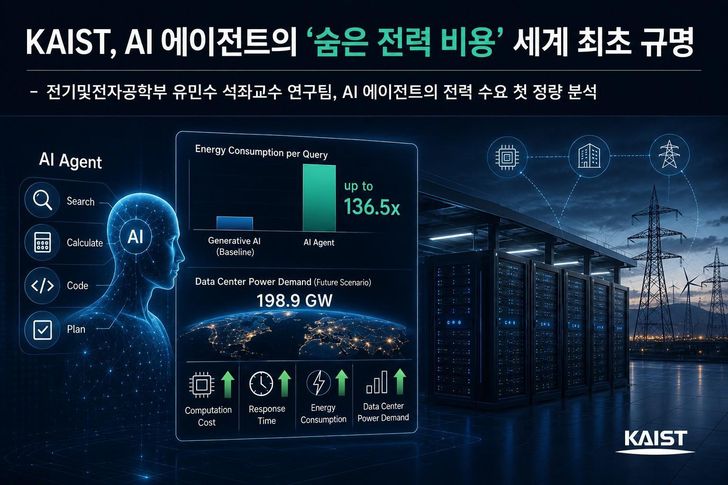
Researchers at South Korea's KAIST have calculated the real energy cost of agentic AI for the first time, finding that a single complex query can consume more than 136 times more electricity than a response from a standard chatbot.
Contents
A team at the Korea Advanced Institute of Science and Technology (KAIST), led by professor Min-soo Rhu, has published the first detailed accounting of how much energy agentic artificial intelligence actually consumes. The results show that autonomous systems, ones that browse the web on their own, run calculations, and execute commands, can use up to 136.5 times more electricity per query than a standard chatbot giving a simple answer.
The difference between a chatbot and an AI agent comes down to how each one operates. A chatbot receives a question and immediately generates an answer. An agent receives a goal, such as planning a trip or managing a budget, and breaks it down into steps on its own: it searches the web for information, runs intermediate calculations, and calls external tools before producing a final result. Each of those steps is a separate query to the model, and therefore a separate energy cost.
Where the gap comes from
Rhu's team measured the energy consumed by an agent's entire chain of actions, from the first query to the final answer, rather than just a single interaction with the model. Calling the same model repeatedly in a loop, to refine a plan, check an intermediate result, or correct an error, makes the total energy cost grow much faster than the length of the final response alone would suggest.
The researchers also flagged another side effect of agentic operation. The GPUs in data centers that handle these queries sit idle more than half the time, waiting for a response from an external source, such as a web search result or a reply from another service. Hardware worth millions of dollars keeps drawing power without performing any computation during that time, which further drags down the energy efficiency of the whole system.
What 13.7 billion queries a day would mean
The most troubling part of the study concerns the industry-wide projection. The authors estimated that if agentic AI reached mass adoption at a scale of 13.7 billion queries per day globally, data center energy demand would approach half of total US electricity consumption. That figure calls into question the industry's current trajectory, in which companies keep racing to offer ever more autonomous agents capable of working independently for hours at a stretch.
Tech companies can't focus solely on making software smarter if they care about a sustainable future - Min-soo Rhu, KAIST
According to the researchers, power grids in their current form cannot support mass deployment of AI agents without a fundamental redesign of the models themselves, the chips that run them, and data center infrastructure. That shifts the debate from whether AI will keep getting smarter to whether the world will have enough electricity to actually use it.
What it means for business
For companies deploying agentic AI, the study has a direct impact on the bill. If an agent handling a single task uses more than a hundred times the energy of a simple chatbot, the operating cost of rolling out agents at scale in a call center, sales team, or customer service department could grow far faster than original return-on-investment calculations assumed. That's an argument for designing agents efficiently, cutting unnecessary model calls and verification loops, rather than simply maximizing their autonomy.
The findings add to a broader concern among power grid operators, who have spent months warning of a sharp rise in electricity demand from AI data centers. In the United States and Europe, companies building new data centers increasingly have to finance their own power plants or dedicated capacity contracts at the same time, because local transmission grids can't keep up with the pace at which the industry's needs are growing.
What comes next
The KAIST team says it will continue working on ways to cut agents' energy use, including chip designs that make better use of the time GPUs spend waiting for external data instead of letting them sit idle. Findings like these could feed into regulatory discussions on AI energy efficiency in the coming months, including in Europe, where data center energy consumption is increasingly being tied to the EU's climate targets.
For the average user, the key takeaway is simple: the more autonomous and multi-step a task handed to AI is, the larger its hidden energy cost, even when the final answer looks just as simple as one from an ordinary chatbot.