News
Moonshot AI Releases Kimi K3, a 2.8-Trillion-Parameter Open Model
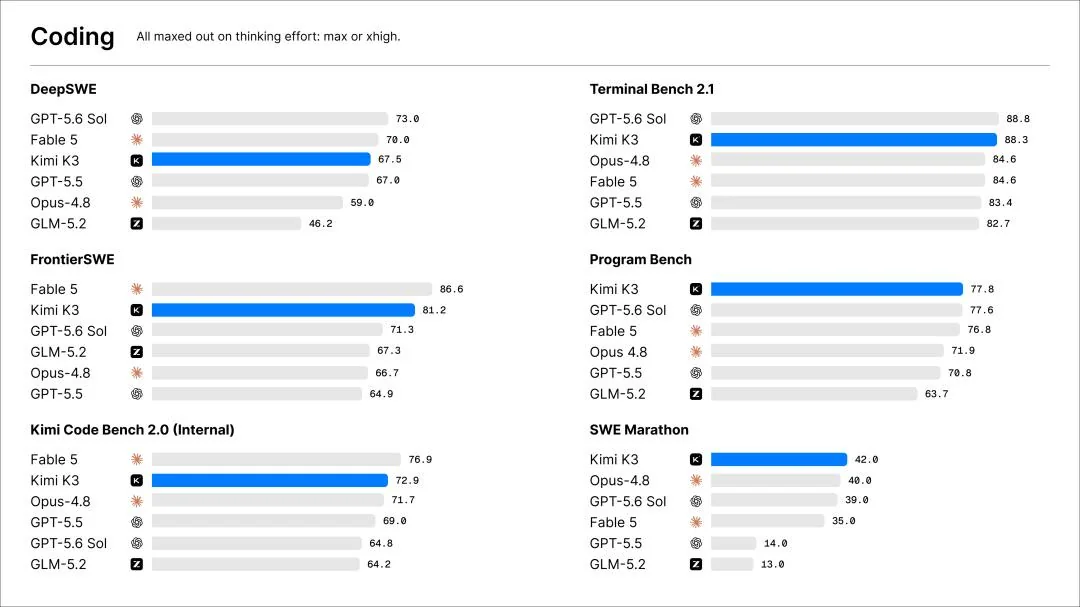
Chinese company Moonshot AI unveiled Kimi K3 on July 16, a 2.8-trillion-parameter model with a million-token context window that, in internal benchmarks, trails only Claude Fable 5 and GPT-5.6 Sol.
Moonshot AI, a Beijing-based startup behind the Kimi family of models, released its latest flagship model, Kimi K3, on July 16, 2026. The company describes it as the largest open language model released to date and touts results that rival the priciest closed models from OpenAI and Anthropic.
Parameters and Architecture
Kimi K3 is a mixture-of-experts model with 2.8 trillion total parameters, which Moonshot says makes it the largest open model released so far. By comparison, China's DeepSeek V4-Pro has 1.6 trillion parameters, Xiaomi's model has 1.02 trillion, and Z.AI's offering has 744 billion. The model uses a new architecture built on the Attention Residuals technique, which Moonshot released as an open replacement for standard residual connections earlier this year.
Another new feature is native image understanding built directly into the model rather than bolted on as a separate vision module. Moonshot pairs this with its coding capabilities, pointing to applications in game development and CAD design, where the model needs to understand code and graphics at the same time.
The context window of up to 1,048,576 tokens is covered under the standard pricing, with no extra charge for using it. Moonshot positions K3 as a model for software engineering, knowledge work, and tasks that require long-form reasoning over large datasets.
Benchmark Results
In Moonshot's internal tests, Kimi K3 ranks third in overall intelligence, trailing only Claude Fable 5 and GPT-5.6 Sol, but ahead of Gemini and other leading providers' models. In individual categories, the model often beats the competition despite its lower overall ranking.
On Program Bench, K3 scored 77.8 points, ahead of GPT-5.6 Sol's 77.6. On SWE Marathon, the model scored 42.0 points versus 35.0 for Claude Fable 5. Terminal Bench 2.1 scored 88.3, and FrontierSWE scored 81.2. On DeepSWE, Kimi K3 scored 67.5 points, trailing Fable 5's 70.0 here.
K3 performs strongly on agentic tasks: 30.8 points on Automation Bench and 34.8 on SpreadsheetBench 2, ahead of both comparison competitors in each case. On the BrowseComp web-browsing benchmark, the model achieved 91.2 percent in a single-agent configuration, without context compression or other context-management techniques. On GDPval-AA v2, which covers 44 occupations across nine industries, K3 scored 1687 Elo points, and on AA-Briefcase it scored 1527 points, placing it second in that ranking.
Pricing and Availability
Via API, Kimi K3 costs $0.30 per million input tokens on a cache hit, $3 per million input tokens without a cache hit, and $15 per million output tokens, with the full million-token context included in that rate. Moonshot also puts the cost of a task on Kimi Code Bench V2 at around $3.50, compared with about $9 for Claude Fable 5.
The API model itself has been available since July 16, while the full model weights are expected to be released publicly around July 27, 2026, likely under a modified MIT license, following the practice used for previous Kimi releases. By market watchers' count, K3 is already Moonshot's ninth record-setting open release in the past year, following the K2, K2.5, K2.6, and K2.7 Code series.
This is our strongest coding model yet, built to handle long software engineering tasks - Moonshot AI, company statement at the launch of Kimi K3
Market Context
The launch coincides with a funding round in which Moonshot AI is raising capital at a $31.5 billion valuation, after the company raised $2 billion in May 2026 at a $20 billion valuation. According to sources cited by the Financial Times, Kimi K3 is expected to match or exceed the capabilities of Anthropic's Claude Opus 4.8, which would make it the most powerful open-weight model to come out of China so far.
The release feeds into a broader industry debate over choosing between expensive closed models from OpenAI and Anthropic and cheaper open-source alternatives. Companies weighing deployments are increasingly looking at models such as DeepSeek, Z.ai, and now Kimi, largely for the ability to retain control over their own data instead of sending it to an outside API provider.
For Polish companies and developers, this represents another low-cost option for local deployment or cheap API access, particularly for coding and large-document-analysis applications, where the million-token context and lower price could meaningfully cut costs compared with closed models. Earlier models in the Kimi K2 family already gained a favorable reception in the open-source market, staying competitive with leading closed models despite significantly lower prices.