News
German Startup OroraTech Launches Satellite Wildfire Detection System in Greece
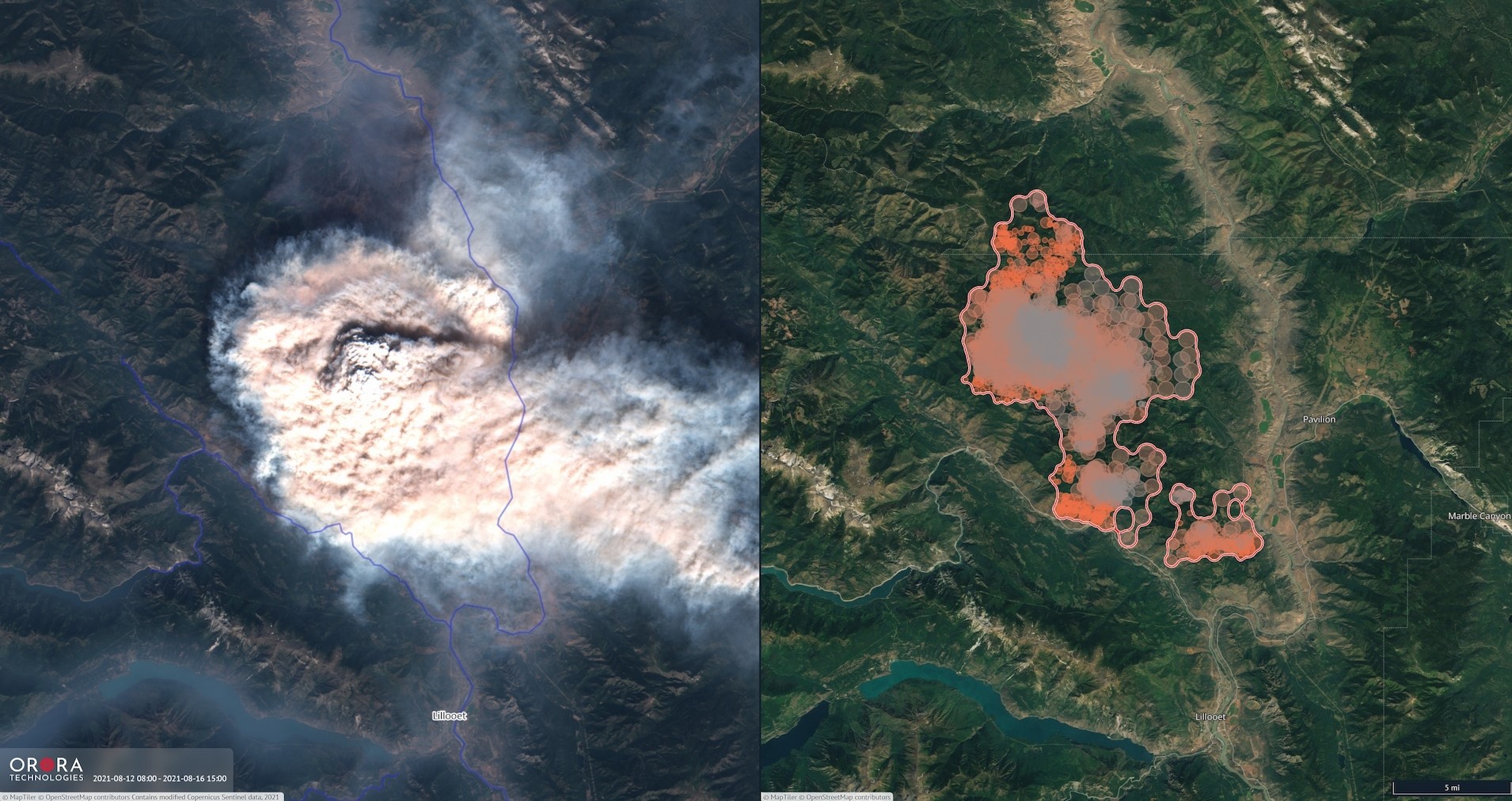
Munich-based startup OroraTech has captured its first images from the Hellenic Fire System, four satellites that have monitored all of Greece for wildfires since May. The AI-powered system is designed to deliver data on new fire outbreaks to firefighters within minutes.
Contents
German startup OroraTech has announced that its Hellenic Fire System satellite constellation delivered its first thermal images of Greece less than a month after reaching orbit. Four dedicated satellites, backed by artificial intelligence algorithms, are designed to detect new wildfires within minutes of ignition and relay the data to the Greek fire service.
OroraTech was founded in 2018 as a spin-off of the Technical University of Munich (TUM). Rather than building large, expensive weather satellites, the company bet on cheap nanosatellites fitted with thermal cameras and placed in low Earth orbit. It supplements that data with feeds from more than twenty other Earth-observation satellites, which it merges into a single analytics system.
How the system works
The core of the system is artificial intelligence that analyzes raw thermal data before it reaches emergency services. The algorithms filter out false alarms, such as sun-heated rocks or emissions from industrial plants, and calculate the location, size and intensity of an actual fire. That lets firefighters prioritize within minutes when several blazes are burning at once.
The four FOREST-16 through 19 satellites were launched on May 4, 2026 aboard a SpaceX rocket from Vandenberg Space Force Base in California. They were placed in a low sun-synchronous orbit at an altitude of roughly 550 kilometers. Less than a month later, on July 7, the system reached so-called first light, its first transmitted thermal images, covering the Athens metropolitan area and the islands of Andros, Tinos, Skyros, Chios, Kea and Kythnos.
First system of its kind in Europe
According to OroraTech, the Hellenic Fire System is the world's first national satellite constellation built solely to detect and monitor wildfires. Once fully operational, the satellites are meant to scan Greece's entire territory twice a day with no gaps in coverage. The data flows directly to Greece's Ministry of Digital Governance, which coordinates the emergency response.
Achieving first light in such a short time shows the maturity of our technology and the outstanding work of our engineering teams - Martin Langer, CEO of OroraTech
For the first time, an entire country is protected by a dedicated satellite constellation - Martin Langer, CEO of OroraTech
The project is funded through the EU's Greece 2.0 National Recovery and Resilience Plan, part of the NextGenerationEU fund. Greece's Ministry of Digital Governance is responsible for implementation, while the European Space Agency (ESA) provides program oversight and technical support. ESA's director of Earth observation programs, Simonetta Cheli, has said the project is meant to enable faster, better-informed responses to natural disasters.
Wildfires as a growing climate risk
Greece has struggled for years with increasingly destructive wildfires that in recent seasons have burned tens of thousands of hectares and directly threatened coastal towns and islands. Earlier warning systems relied mainly on ground sensors, aerial patrols and data from weather satellites that were never designed specifically to spot small, newly ignited fires quickly.
OroraTech's technology is not an isolated case. Other players are also working on satellite- and AI-based fire detection, including Google with its FireSat project, a sign that the space-tech sector is increasingly pairing cheap nanosatellites with machine-learning models instead of relying solely on costly government infrastructure.
Relevance for Europe and Poland
For Polish readers, the project matters mainly as a template for funding and deployment: another example of EU recovery funds being used to build AI-based space infrastructure, an area where Poland is simultaneously seeking a stake in Europe's AI gigafactory initiative and developing its own defense and monitoring projects, such as the Pustulka drone-detection system. The rising number of extreme heatwaves and droughts in Central Europe means similar early-warning systems could extend beyond Greece in the coming years.
OroraTech says its services are already used on six continents, including Australia, Brazil, Canada and the United States, and the company plans another funding round later in 2026 to complete the vertical integration of its business, from sensor design through satellite construction and launch to in-house thermal data processing.