News
Unitree's Shanghai Stock Debut Reveals the Scale of China's Humanoid Robot Race
Demand for shares in Chinese robot maker Unitree exceeded supply by 5,500 times at its stock market debut, sending the price soaring more than 600 percent. It's a symbolic moment in China's state-backed humanoid robotics offensive aimed at overtaking US technological dominance.
Contents
The stock market debut of Chinese robot maker Unitree on Shanghai's STAR Market showed just how much capital is now chasing the humanoid robot race. Demand for shares outstripped supply by 5,500 times, and the price rose more than 600 percent in the first hours of trading. The event coincided with a US decision to ban imports of Chinese humanoid robots, justified on national security grounds.
Capital Votes for China
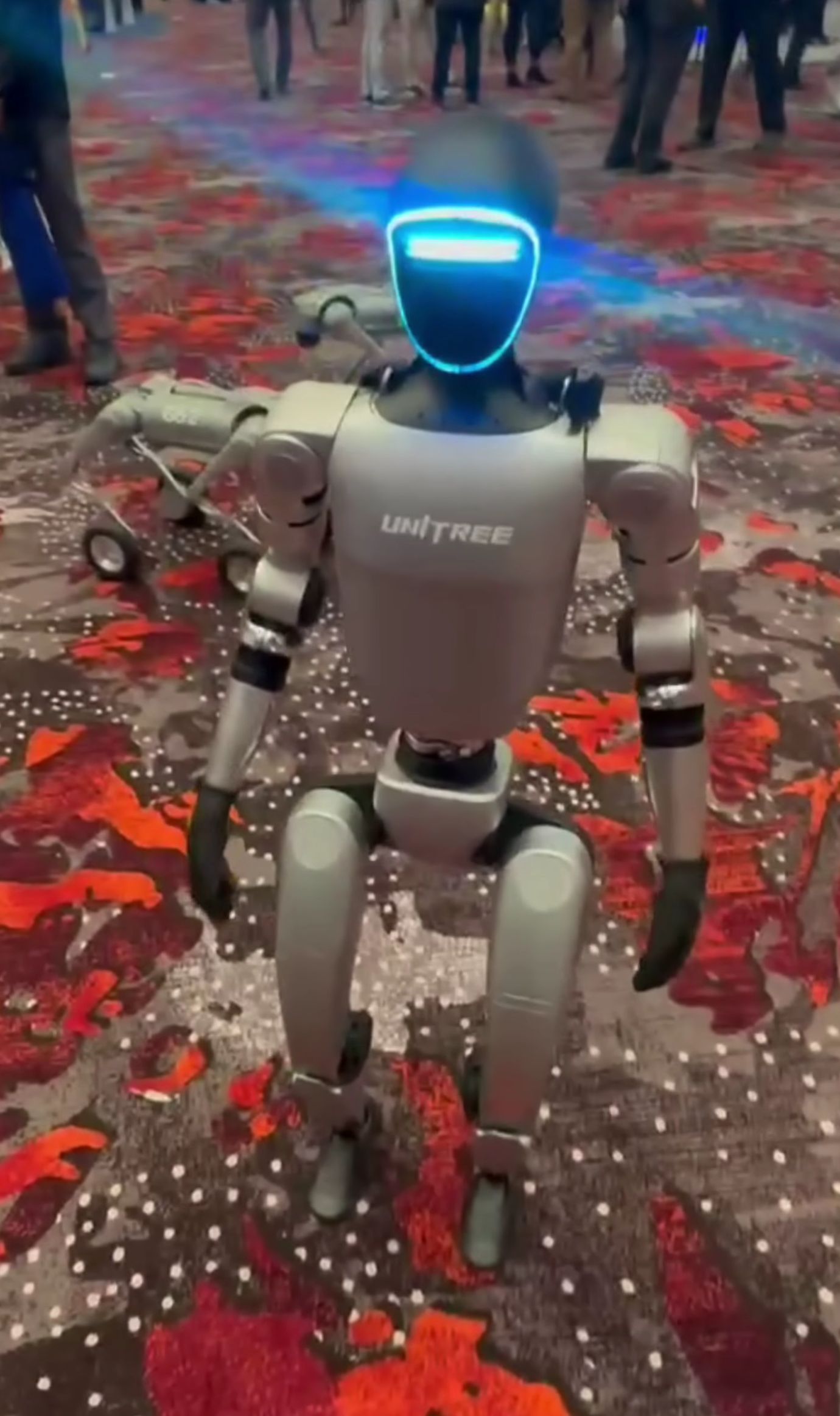
The scale of investor interest in Unitree's debut is unusual even by the standards of China's capital market. Oversubscription of roughly 5,500 times means more than five and a half thousand orders were placed for every share on offer, while the price itself jumped more than 600 percent above the issue price on debut day. Unitree, one of China's best-known robot makers, has spent years developing both quadruped industrial robots and humanoids meant for factory and home use.
In recent months the company showed off a model capable of jumping two meters from a standstill and running at speeds above 12 meters per second. Another robot on display, informally described as a household helper, can unpack groceries, load a dishwasher and sort laundry. The demonstrations are meant to show that Chinese humanoids are already moving beyond showcase stunts into real-world use.
A State Production Plan
Behind Unitree's surge in value is a broader, state-backed program to develop humanoid robotics. The deputy director of the Science and Technology Department at China's Ministry of Industry and Information Technology said domestic humanoid robot production should exceed 100,000 units in 2026, up from 16,000 produced the year before. Morgan Stanley analysts are more cautious, estimating 50,000 units this year, but the direction of growth is not in dispute.
Looking further ahead, Barclays projects that by 2035 China alone will have 11.3 million humanoid robots in operation, while the rest of the world combined will have fewer than 2 million. China's market for this category of hardware is expected to grow from its current $2 billion to $15 billion in 2030. Beijing is treating humanoid robotics much as it once treated electric vehicles, as a strategic sector where state support, production scale and fierce price competition are meant to give domestic firms a lasting edge over Western rivals.
Washington Responds With a Ban
The US response came almost simultaneously with Unitree's debut. American authorities introduced a ban on imports of Chinese humanoid robots, citing the risk that the machines could be remotely hijacked and could collect data that might end up with foreign intelligence services. Congressman John Moolenaar, one of the authors of the restrictions, argued for the need to limit Chinese manufacturers' access to the US market.
We cannot allow these robots to become dominant in our country - John Moolenaar, US congressman
Chinese state media responded to Washington's decision with a sharp rebuke. The Global Times wrote bluntly that the ban amounted to an admission of defeat in technological competition.
If you can't beat them, block them - Global Times
Who Else Is in the Game
The US answer to China's offensive rests mainly on Tesla, whose chief Elon Musk has spent months promising mass production of the Optimus humanoid. Smaller players are also entering the field, such as Foundation Robotics, which showed its Phantom MK1 robot to the US Department of Homeland Security. Chinese tech giants Tencent and Alibaba have performed noticeably worse on the stock market than specialized robot makers like Unitree, suggesting investors are now rewarding narrow robotics specialization over broad AI-sector exposure. Analyst Xiang Ligang said the US restrictions effectively amount to an admission that America's old technological edge has been lost.
The US knows its former technological advantage is eroding fast - Xiang Ligang, analyst
Where Europe and Poland Stand
In this landscape, Europe, including Poland, remains on the sidelines of the humanoid robot production race for now, with no domestic manufacturer able to match the scale of Unitree or Tesla. For Polish industrial and logistics companies, this means access to cheap, mass-produced humanoids in the coming years will depend largely on how the trade dispute between Washington and Beijing plays out, and on whether the European Union decides to impose its own import restrictions similar to those in the US. Unitree's debut shows that investors now see humanoid robots as one of the hottest categories at the intersection of hardware and artificial intelligence, even though current models still perform simple tasks with only about 20 percent of human efficiency.